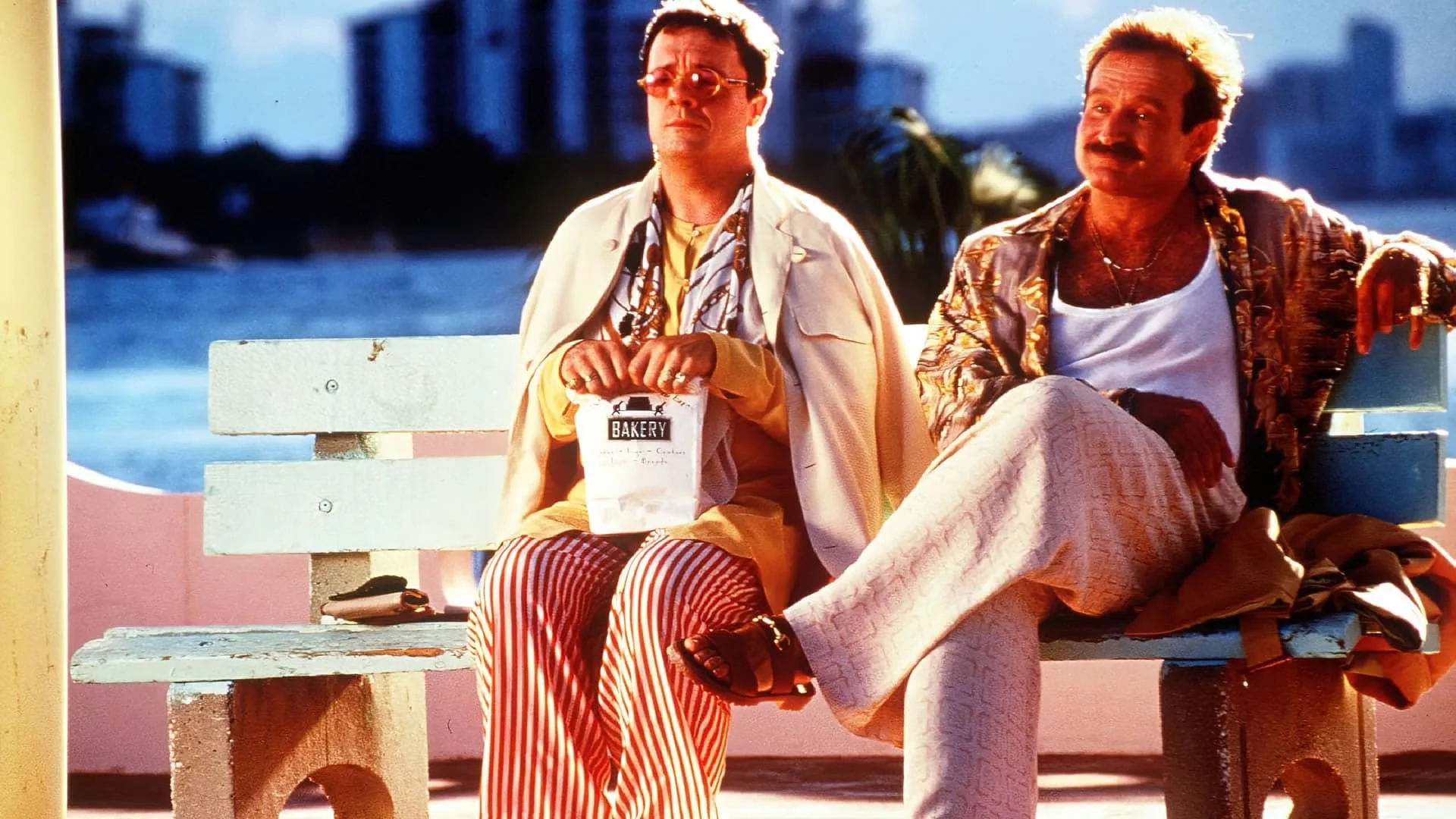
Free as a Bird(cage)
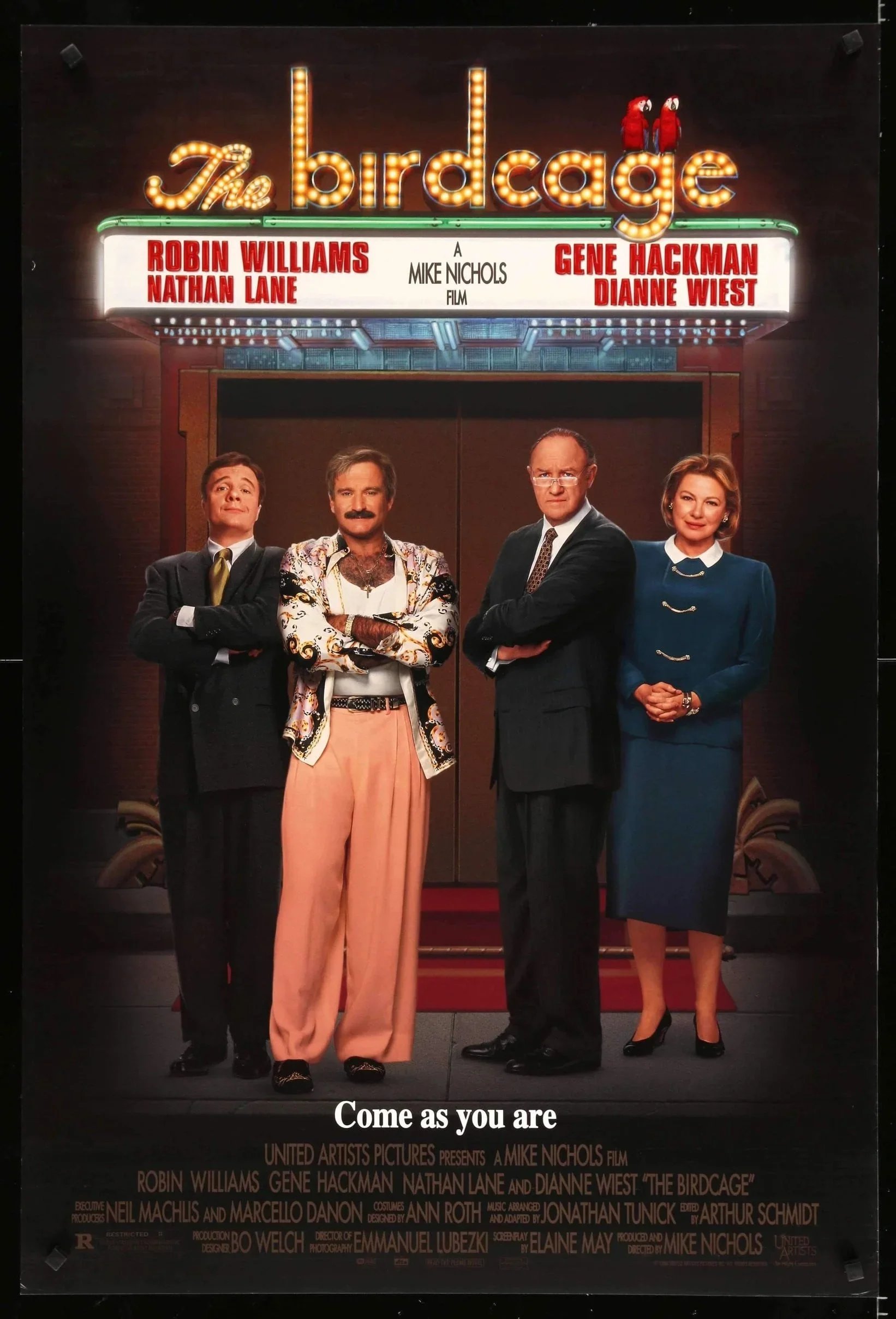
Thirty years ago, director Mike Nichols and his improv partner, writer Elaine May, unleashed one of the finest comedies of the nineties – The Birdcage.
Starring Robin Williams, Nathan Lane, Gene Hackman and Dianne Wiest, this ensemble comedy farce is just as sharp and funny in 2026 as it was in 1996.
And it was during a trip to see it for the first time on the big screen – re-released to celebrate its big birthday – that I suddenly realised quite how important this film is.
Not just for what it did for Nathan Lane’s career (or as a showcase for Hank Azaria’s very impressive abs), but for its place in gay cinema, and the role it played in helping to shift attitudes towards gay men.
So pour a large glass of chilled white wine (we’re not doing red because of the tannins), and join me for a stroll down memory lane as I explore why The Birdcage was, and remains, a big fat gay force to be reckoned with.
Nineteen Ninety-Shit
The year is 1996.
John Major is Prime Minister after his unexpected election win against Neil Kinnock in 1992.
Tony Blair is on the horizon, but for now he’s still just promising that “things can only get better” from the sidelines.
Which feels ambitious, frankly, when Dolly the sheep has just become the first cloned mammal, the Nintendo 64 has arrived, the Spice Girls are dominating the charts and big-budget blockbusters like Independence Day are playing to packed audiences.
But under the surface, gay rights weren’t in the best of places.
If you wanted to join the army and serve your country, you were not exactly welcomed with open arms. In the US, “don’t ask, don’t tell” was still the official line, while in the UK, gay people were still banned from serving openly in the armed forces.
The age of consent still wasn’t equal for gay and straight people, and legal battles were being fought on both sides of the Atlantic. Most notably, President Clinton had signed the Defence of Marriage Act, defining marriage at a federal level as the union of a man and a woman.
And here in the UK, Section 28 - Margaret Thatcher’s stab at stifling the awareness of homosexuality altogether - was still government policy, and would remain so well into Blair’s tenure too.
But there was some hope.
Emerging from the darkest days of the HIV/AIDS epidemic, which had claimed so many lives, new treatments and groundbreaking drugs were beginning to change what a diagnosis meant. What had once felt like an almost certain death sentence was becoming something people could survive.
Court battles were starting to move in favour of equality, and public sentiment was beginning to shift. But the fight was far from over.
Pride wasn’t just a piss up. It was firmly a demonstration – a reminder that love should be equal for all.
Don’t use that tone to me
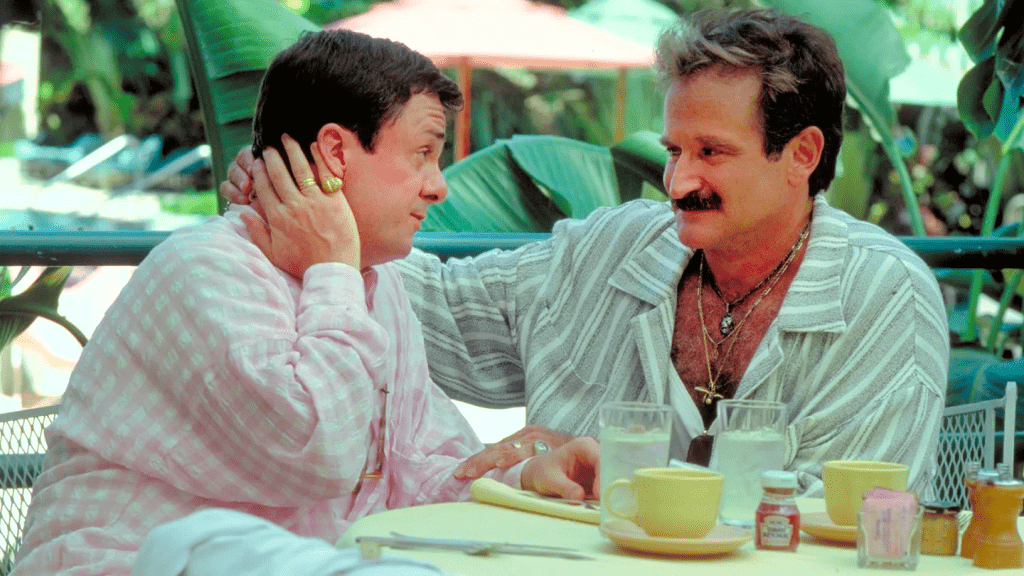
Against a polarised landscape, we shouldn’t underestimate the significance of a major motion picture release like The Birdcage.
While the winds were changing, there was no guarantee mainstream audiences would flock to see a film about a gay couple that owned a drag club in South Beach.
Remember, this was before Queer as Folk. Before Brokeback Mountain. It was even before the seminal coming-of-age film adaptation of Jonathan Harvey’s sublime Beautiful Thing - although only by a matter of months.
Originally conceived as a comedy vehicle for Robin Williams and Steve Martin - with Martin set to play Armand, the role Williams would eventually take when Martin pulled out - The Birdcage was actually a remake of the French film La Cage aux Folles. That film was itself adapted from the 1973 play of the same name.
But while the story had already existed for more than 20 years, it was the star power of Williams and Hackman, coupled with hilarious performances from Lane, Wiest, Azaria and Christine Baranski, that helped launch it into something much bigger. Suddenly, this wasn’t just a beloved queer farce with international roots.
It was a mainstream Hollywood hit.
So much so, The Birdcage would go on to be the biggest comedy of the year.
Now’s the time to pretend
To really understand attitudes towards gay men in 1996, you only have to look at a promotional interview Robin Williams and Nathan Lane gave to Oprah Winfrey.
Lane was 40 at the time, but still relatively unknown to mainstream audiences - aside, perhaps, from his voice work as Timon in 1994’s The Lion King. He was already an acclaimed theatre actor, but The Birdcage became his Hollywood breakout. He has said as much himself many times since.
So imagine suddenly finding yourself on the biggest talk show in America, sitting next to one of the biggest comedy stars in the world. Daunting enough for any actor. But for Lane, a gay actor from New Jersey, stepping into the spotlight with a major gay role in a huge studio film, it must have come with an added layer of pressure to say the least.
And in 1996, a guy’s sexuality was all anyone could talk about. Be it tabloid gossip or social speculation – the appetite to discuss a celeb’s sexuality was everywhere.
That continues, of course, but it’s far less salacious these days. I mean, no one’s jaw is going to hit the floor if speculation around Tom Cruise or John Travolta turned out to be true, are they?
For an emerging actor playing a gay role in a mainstream hit, though, there was little room to avoid the subject. Especially in front of an audience hungry for a revelation.
Thank God for allies. And what better ally could Lane have had than Robin Williams? As Oprah edged towards Lane’s sexuality, Williams effortlessly batted the question away with his sharp comic instincts, flipping the attention back on her and protecting Lane in the process.
If it wasn’t for the pirin, I don’t think I could go on
Despite the wild comedy set pieces, at its heart, The Birdcage is a story about two men who love each other very much. And that fact is presented without pomp or ceremony. It just is what it is.
There’s no dramatic realisation for the central pair. No coming to terms with what it means to be gay.
How refreshing that is.
That said, their lives aren’t simple. They run a business, and they live above it, but there’s no protection for either of them. No marriage. No civil partnership.
If one dies, or leaves, the other is screwed.
And this core tension is explored through Armand’s son, Val.
Val is, in my opinion, the villain of the piece.
While he seemingly accepts his less-than-traditional family, he still insists his dad butch up and send Albert away when “other people” are coming round. Albert (Lane) is too camp. Too unusual. Too much for his fiancée’s family to accept. That family being a Republican senator and his strictly conservative wife.
This is where the film touches a nerve, because it taps into a reality almost every gay man has had to navigate at least once.
Do you dial your personality up? Or do you tone yourself down?
Do you constrict who you are to fit into society, or do you think, bollocks to that, and go bigger and louder to make up for years of repression?
I know I’ve found myself in social situations leaning into conversation topics I’m less comfortable with to appease the football fan I’m standing next to at the bar. I’ve also caught myself taking a beat before correcting an electrician or plumber when he refers to my partner as “she”, because he assumes it must be.
I’ve often been told I’m blessed to be “straight acting” - afforded a life that must be so much easier.
Maybe it is in some ways.
But there’s no acting involved. I don’t get home after a night out and take my skin fade off to make way for bleached locks and a lisp.
The gay community is, to its strength, made up of every type of person you can imagine.
As Derek Jarman said: “We are you.”
And it’s in that simplicity that I take such comfort from a film like The Birdcage.
And it’s why, even in 1996, the biggest comedy can be about two middle-ages fags that love each other.
It really is as simple as that.